![Shaanxi Lingkang Times Biotechnology Co., LTD]() Shaanxi Lingkang Times Biotechnology Co., LTD
Shaanxi Lingkang Times Biotechnology Co., LTD

Last month a softgel manufacturer asked us the same question twice: why is your 20,000 FU nattokinase powder nearly double the price of another supplier's.
We asked for both certificates of analysis. One lab ran the fibrin plate method. The other ran UV spectrophotometry. That explained the whole gap.
If you buy nattokinase powder in bulk, the testing method behind the FU number matters more than the number itself. This guide explains why, along with the production, specification, and regulatory details we get asked about most often.
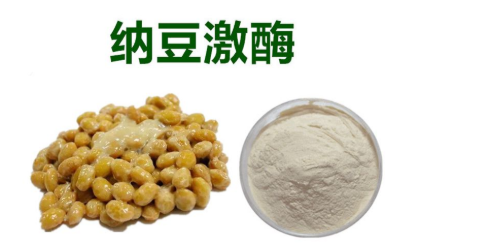
Nattokinase is a serine protease in the subtilisin family, molecular weight around 27.7 kDa. Dr. Hiroyuki Sumi identified it in 1980 while screening natto extract for fibrinolytic activity. The enzyme is secreted by Bacillus subtilis natto during soybean fermentation. In plain terms, it is a metabolic product of the fermentation, not an extract of the bean itself.
Japan has consumed fermented soybeans for over a thousand years and remains the largest nattokinase market. Demand elsewhere has grown quickly in the past few years, driven by cardiovascular supplement formulas. Wherever demand rises fast, the supply side gets messy. That is not a jab at any particular competitor. It is what happens in every young ingredient market.
Traditional natto is solid-state fermented. Steamed soybeans are inoculated and held at around 40 °C overnight, which produces the sticky, stringy food. Enzyme activity from this route lands roughly between 1,000 and 3,500 FU/g, and the material carries live bacteria, purines, and the strong smell most formulators want to remove.
Ingredient-grade nattokinase powder takes a different route: submerged liquid fermentation. Soybean peptone serves as the culture medium. The process controls temperature, pH, and dissolved oxygen, then removes the bacterial cells by centrifugation, purifies through ultrafiltration and chromatography, and dries the liquid into powder. Activity reaches 20,000 FU/g and above, with the highest grades around 65,000 FU/g.
Drying is where batches are won or lost. Nattokinase is a protein and denatures irreversibly under heat. Some producers spray-dry with inlet air at 170 to 180 °C. How much activity survives is a question each of them answers privately. We freeze-dry at low temperature instead. It costs more energy and cuts batch capacity, and we accept that trade because activity lost in drying is activity the customer pays for twice.
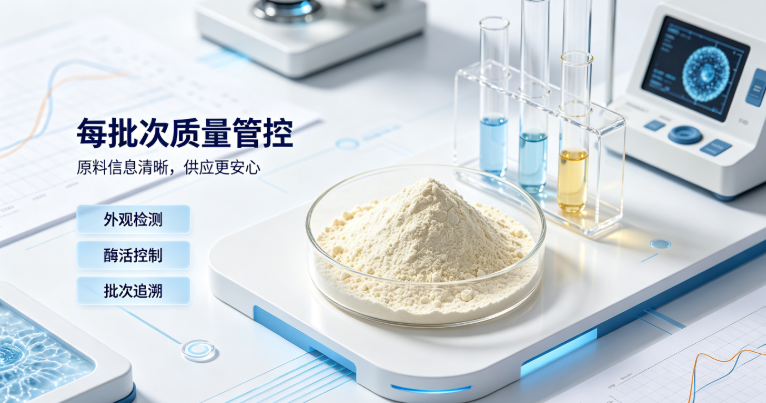
FU stands for fibrinolytic unit. It sounds like a standardized measure. It is not. At least three methods are in common use, and they have no fixed conversion between them.
Fibrin plate assay. The oldest method. Fibrin is layered on an agar plate, the sample is spotted on top, and the lab measures the diameter of the clear zone. It measures real dissolving capacity, closest to how the enzyme behaves in the human body. It is slow, taking one to two days, and the zone is measured by hand. Results between labs can differ by 20 to 30 percent.
UV spectrophotometry. Fast and cheap, so many factories use it for routine release testing. It tracks absorbance change as protein degrades, and it is sensitive to temperature, pH, and substrate concentration. If conditions are not standardized, results drift.
HPLC. Measures protein content with the best accuracy. The equipment is expensive, so it usually appears on export orders and purity studies rather than routine batches.
Here is the practical problem. One batch of powder can read 20,000 FU by plate assay and 35,000 FU by UV method. A supplier quoting the UV number looks cheaper and stronger on paper. The customer re-tests by plate assay, finds half the labeled activity, and the dispute goes nowhere.
Our standing advice to buyers is simple. When you sign a quality agreement, write the method, the reference standard, and the retest arbitration method into the document. A number on a COA means little without the method that produced it.
The first is vitamin K2. Natto fermentation produces K2 alongside the enzyme. K2 is a valuable nutrient on its own, but for products positioned at people taking warfarin or similar anticoagulants, it interferes with the medication. Formulations targeting that group need a K2-removed grade. Many purchasing teams learn this after the first sample round, when formula rework costs are already sunk.
The second is soy allergen labeling. The raw material is fermented soybean, and both the US and EU markets enforce soy allergen declaration. Export buyers should budget for label and compliance work before committing, not treat it as a line item added later.
Heavy metals and micro limits are baseline items. Total plate count, E. coli, and Salmonella should appear on every batch COA. These are floor requirements, not selling points.
The activity number on the raw material is only the starting point.
Nattokinase does not tolerate the stomach. Gastric acid sits near pH 2, and the enzyme loses activity quickly in that environment. A 20,000 FU/g powder filled into a standard hard capsule delivers an unknown fraction to the intestine.
Three solutions are common. Enteric capsules resist gastric acid and release in the intestine. Microencapsulated powder wraps the enzyme in a wall material, which suits formats where enteric shells are impractical, such as powders, gummies, and drinks. A third approach adds stabilizers during freeze-drying to raise acid and heat tolerance through formulation alone.
When customers ask whether we carry an encapsulated grade, we ask what the finished product is. The same enzyme in a tablet versus a drink mix calls for completely different material.
Blending deserves a note too. Nattokinase is frequently combined with red yeast rice, CoQ10, or fish oil. Water activity and pH interact in the blend, and in powder mixes slight moisture uptake starts eroding activity. Small-scale trials do not always reveal this. It shows up after scale-up, sometimes after a batch has already shipped.
China has no national standard for nattokinase yet. The closest reference is the Guangdong provincial standard DBS 44/013-2019 for natto powder, which lists nattokinase activity as the main physicochemical index and specifies UV spectrophotometry and the agarose fibrin plate method. Provincial standards have limited scope, but the standard at least fixes activity as a definable index.
In the EU, nattokinase follows the novel food equivalence route. In the US it is used as a dietary supplement ingredient under DSHEA. Japanese and Korean markets are mature and well defined.
Item | Typical Range |
Activity | 5,000 / 10,000 / 20,000 FU/g (higher grades on request) |
Appearance | Off-white to light yellow fine powder |
Source | Bacillus subtilis natto fermentation of soybean |
CAS No. | 133876-92-3 |
Testing method | Fibrin plate assay as release method; HPLC available |
Vitamin K2 | Standard grade / K2-removed grade |
Microencapsulated grade | Available |
Packaging | 25 kg fiber drum with double PE liner; 1 kg foil bag for samples |
MOQ | 1 kg |
Shelf life | 24 months sealed, away from light and moisture |
Is a higher FU/g number always better?No. Compare numbers only when the testing method matches. A 20,000 FU/g result by plate assay and a 20,000 FU/g result by UV method are not equivalent claims.
Do you offer enteric-coated or microencapsulated nattokinase?Yes. We produce microencapsulated grades for powder, gummy, and beverage formats. For capsules we supply the plain powder and leave the enteric shell to your capsule supplier.
Which activity grade suits a daily cardiovascular supplement?Most finished products on the market deliver 2,000 FU per serving. The raw material grade depends on your capsule fill weight and the delivery format.
Can you remove vitamin K2?Yes, we offer a K2-removed grade for products targeting anticoagulant users. State this requirement at inquiry stage because it affects production planning.
How is the powder shipped for export?Sealed 25 kg drums with double PE liners, palletized. Full export documentation, COA, and third-party retest support are available per shipment.
We are a plant and microbial extract manufacturer based in Shaanxi, China. Nattokinase runs on our own production line, from strain expansion and fermentation through ultrafiltration and freeze-drying. We do not trade or relabel material from other factories.
Request a sample and test it yourself, in your own lab or a third party, before you trust any number on this page. That advice applies to us as much as anyone.