![Shaanxi Lingkang Times Biotechnology Co., LTD]() Shaanxi Lingkang Times Biotechnology Co., LTD
Shaanxi Lingkang Times Biotechnology Co., LTD

Search for "purple yam powder" and you will find three different products under one name. One is ground dried tuber. One is a spray-dried juice powder. One is an extract standardized to anthocyanins. They behave differently in a formulation, cost differently, and pass different specs. Buying the wrong one is the most common mistake we see from first-time buyers.
This guide covers the botanical identity, the three processing routes, what is actually in the powder, the specs to put on a purchase order, the color stability story, and the documents to ask a supplier for before you wire any money.
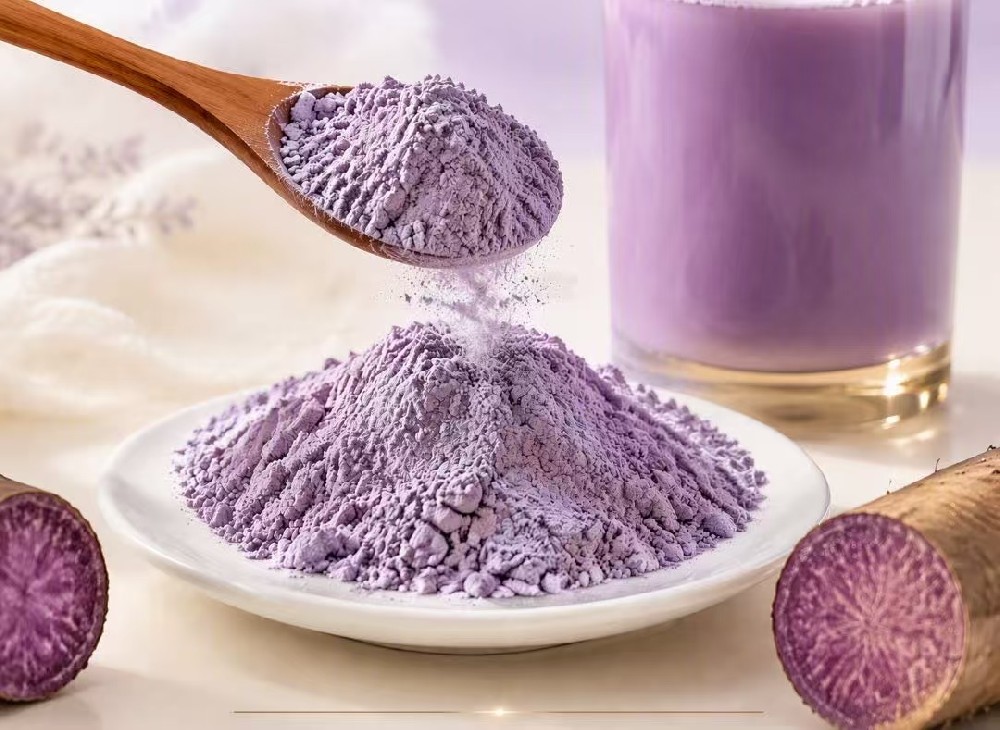
Purple yam powder and fresh Dioscorea alata tubers. Color in the powder depends on cultivar, growing conditions and processing route.
The label confusion is the single biggest source of complaints. Here is the short version.
Purple yam is Dioscorea alata L., a true yam in the Dioscoreaceae family. Other common names: water yam, winged yam, greater yam, and ube in the Philippines. The tuber has a rough brown or purple-brown skin and violet to near-white flesh depending on cultivar. Grown in Fujian, Jiangxi, Guangdong, Guangxi and Taiwan in China.
Purple sweet potato is Ipomoea batatas, a member of the morning glory family. The two are unrelated botanically, their starches behave differently, and their anthocyanin profiles differ. Purple sweet potato is dominated by peonidin-based pigments, purple yam by cyanidin and delphinidin glycosides, including the characteristic alatanin C.
"Ube flavor" sold in the US baking aisle is often a blend of purple sweet potato powder with added flavor and color. It is not purple yam at all.
If your product label says "yam" or "ube", purple sweet potato powder does not legally qualify in most jurisdictions. Get the botanical name on the spec sheet before you commit.
How purple yam powder is made
There are three routes, and they are not interchangeable.
Dried and milled flour. Fresh tubers are washed, peeled, sliced 3-5 mm, dried at 50-65°C in a hot-air dryer, and milled to 80-200 mesh. The result is a non-soluble powder that carries starch, fiber and a lot of the natural pigments bound to fiber. Cheapest of the three. Gritty at high load, so it is mainly used in bakery at 3-8% of flour weight and in noodles.
Spray-dried juice powder. Fresh tubers are pulped and pressed. The juice is clarified, blended with a carrier (usually maltodextrin DE 10-20) at 10-30%, and spray dried at an inlet of 180-200°C and an outlet of 80-95°C. The result dissolves readily in water, gives a clean purple drink, and concentrates anthocyanin by a factor of 5-10 over flour. Standard in beverages, dairy and ice cream.
Extract powder. Milled flour is extracted with water or aqueous ethanol, filtered, concentrated under vacuum, and spray- or vacuum-dried. Often standardized to anthocyanin content (5%, 10%, 25% as cyanidin-3-glucoside) or to an extract ratio (4:1 to 20:1). Used in capsules, tablets, gummies, and high-end drink mixes.
Anthocyanins. Cyanidin-3-glucoside and delphinidin glycosides are the main pigments, with smaller amounts of peonidin and acylated forms such as alatanin C. Fresh purple yam flesh typically contains 20-60 mg anthocyanins per 100 g fresh weight depending on cultivar and growing conditions. The peel holds 3-5x more than the flesh. Spray-dried juice powder usually runs 0.3-1.5% total anthocyanins on a dry basis. Extract powder can be standardized higher.
Dioscin and diosgenin. Steroidal saponins. Diosgenin is the most common marker compound in quality control. Total steroidal saponins in D. alata tuber are typically under 1% dry weight, much lower than in Dioscorea zingiberensis (a different species, and the real industrial source of diosgenin). If a supplier claims a "high diosgenin" purple yam extract, ask for the HPLC chromatogram.
Allantoin. A cell-proliferation compound also used in cosmetics, present at a few tenths of a percent in the fresh tuber.
Mucilage polysaccharides. The slime you see when cutting a raw yam. Water-binding, contributes to mouthfeel in drinks and viscosity in some bakery applications.
Resistant starch and dietary fiber. Raw purple yam starch is high in resistant starch, which drops after cooking. Dried flour typically contains 6-10% total dietary fiber.
Minerals. Potassium (around 300-500 mg per 100 g dry), manganese, copper.
| Parameter | Typical range | Notes |
|---|---|---|
| Appearance | fine purple powder, hue varies by cultivar | request a color reference photo per lot |
| Mesh | 80 / 100 / 200 mesh, or 95% pass 80 mesh | finer = more dust, better dispersion |
| Moisture | ≤ 8% (flour); ≤ 5% (spray-dried) | above 8% it will cake in storage |
| Ash | ≤ 6% (flour); ≤ 8% with carrier | carrier inflates ash |
| Anthocyanin (UV-Vis as C3G) | 0.3-1.5% juice powder; 5-25% extract | state the method; UV-Vis pH-differential and HPLC differ |
| Total plate count | < 10,000 cfu/g (food); < 1,000 (supplement) | |
| Yeast and mould | < 100 cfu/g | |
| E. coli / Salmonella | negative / 25 g | |
| Lead | < 0.5 mg/kg (EU); < 1.0 (some markets) | check the destination market |
| Arsenic, cadmium, mercury | per destination market | |
| Pesticide residue | EU MRL or customer list | request a third-party SGS / Eurofins / Intertek report |
| Solvent residue | only if extract; state ethanol or IPA | |
| Carrier | maltodextrin DE 10-20, or none | declare on the label |
Ask for a per-lot COA. UV-Vis and HPLC anthocyanin numbers are not directly comparable; the supplier should report the method.
Most complaints from new buyers are color-related, and most are predictable. Anthocyanins are pH sensitive: red below pH 3, purple at 4-5, blue-grey and unstable above 6. They degrade above 70°C with prolonged heating. Ascorbic acid accelerates fading. Light and Fe/Cu ions dull the color. Practical notes for formulators:
For beverages, keep the finished pH between 3.0 and 3.8. Pasteurize hot and short (95°C for 15-30 s) rather than 75°C for 30 min. Use 304 or 316 stainless lines, not copper or iron.
For bakery, expect a visible color shift to a deeper, more blue-grey hue during baking. The crumb will not be as bright as the dough. If you need a stable bright purple, look at extract powder with a higher load, or plan the color shift into your SKU and label design.
For capsules and tablets, ask for an extract grade with maltodextrin or inulin carrier. A 5-10% anthocyanin grade is common and stable.
| Use case | Recommended form | Typical dose |
|---|---|---|
| Beverages and drink mixes | spray-dried juice powder | 0.5-3.0% w/v |
| Bakery (bread, mooncakes, mochi) | dried and milled flour | 3-8% of flour weight |
| Dairy and plant-based (yogurt, ice cream, oat milk) | spray-dried juice powder | 0.3-1.5% |
| Capsules, tablets, gummies | extract powder 4:1-10:1, or 5-10% anthocyanin | per formulation |
| Cosmetics (soap, masks, scrubs) | extract powder or juice powder | per formulation |
| Pet food and treats | dried and milled flour | 1-3% |
Certificate of Analysis (COA) per lot, with method references
Technical specification sheet and MSDS
Process flow chart, with the thermal steps called out
Allergen and GMO statement
Halal and Kosher certificates if your market needs them
Organic certificate (EU 2018/848 or USDA NOP) if "organic" is on the label
Country of origin, harvest season, and retention sample policy
Third-party heavy metals and pesticide residue reports (SGS, Eurofins, Intertek, or equivalent)
Non-irradiation / ETO treatment statement
Is purple yam powder the same as ube powder?
In the US market the two names are often used interchangeably. Ube is the Filipino name for Dioscorea alata. Some products sold as ube powder are purple sweet potato blends. The botanical name on the spec sheet settles the question.
Is it water soluble?
Milled flour is not; it disperses in water and settles. Spray-dried juice powder dissolves readily. Extract powder dissolves depending on the carrier.
What is a normal MOQ and lead time?
Most Chinese factories quote 25 kg for stock grades and 100-500 kg for custom specifications. Sample size is usually 100-500 g. Lead time: 15-25 days for stock grades, 30-45 days for custom specifications, plus sea freight.
Send us your spec.
Tell us your target spec, application and expected monthly volume, and we will send a 200 g sample with a current COA and a draft specification sheet within 48 hours. Pilot batches of 5-50 kg are available for trial production runs.