 WhatsApp: +86-13379040254
Welcome to Lingkang Times Biology
 Shaanxi Lingkang Times Biotechnology Co., LTD
WhatsApp: +86-13379040254
Shaanxi Lingkang Times Biotechnology Co., LTDAsk ten suppliers for a ginseng extract sample and you will get ten different powders. Some are near-white, some are tan, some smell faintly sweet, some smell like damp earth. All of them will be called "ginseng extract." Most of them will be quoted with a ratio — 10:1, 20:1 — and almost none of them will tell you what that ratio actually refers to.
This article is written for the people on the buying side: formulators, brand owners, importers and procurement managers who need to compare quotes that look identical on paper and are not identical in a drum. Nothing here is a health claim. It is a checklist.
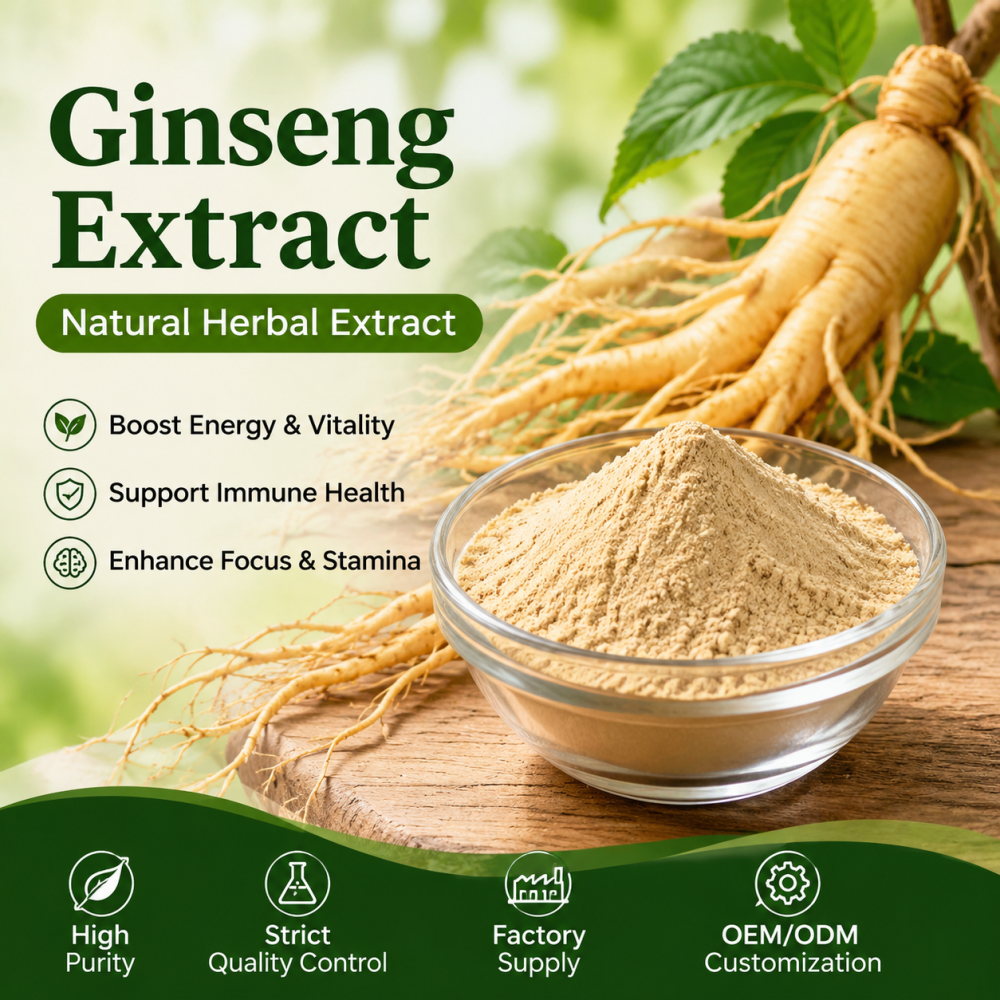
"Ginseng" is not one material.
Panax ginseng (Asian ginseng) is grown mainly in Northeast China and Korea. Panax quinquefolius (American ginseng) is grown in North America and increasingly in China as well. They are different species with different ginsenoside profiles — Asian ginseng typically carries more Rg1 relative to Rb1, American ginseng the reverse. If your specification sheet does not name the species, you do not know what you are buying.
The second distinction matters more than most buyers expect: root versus leaf versus stem. Root extract is the material most buyers assume they are getting. Leaf and stem extracts exist, cost less, and are legal to sell — but they are a different raw material with a different profile. Ask which plant part went into the extractor. A supplier who cannot answer this question in one email is telling you something useful.
This is where most purchase decisions go wrong.
A 10:1 extract means, in principle, that ten kilograms of raw herb went in and one kilogram of extract came out. That is a statement about mass, not about what is in the powder. It says nothing about ginsenoside content, and it is compatible with a powder that has been heavily extended with carrier.
A standardized extract is specified on an active marker — for example, "total ginsenosides 10% by HPLC" or "20%". That number is measured, batch by batch, and it is the number your formulation actually depends on. It is also the number a regulator or your customer's auditor will ask you to prove.
Two practical consequences:
A 10:1 liquid extract has to be spray-dried onto a carrier to become a powder. Maltodextrin is the usual carrier, and it is not unusual for a finished "10:1 powder" to be 30–50% carrier. The ratio on the label survives; the potency does not.
A standardized extract is usually quoted with both the marker content and the carrier level, because the two together define what you are paying for per kilogram.
If a quote gives you a ratio and no marker, ask for the HPLC chromatogram of the actual batch, not a generic spec sheet. If a quote gives you a marker and no ratio, ask for the extraction input-to-output yield, because that is where the cost sits.
Two routes dominate commercial production.
Water extraction is the cheaper, higher-throughput route. It pulls a broader spectrum — polysaccharides, some amino acids, water-soluble sugars — and produces an extract that is darker, more hygroscopic, and often more strongly flavored. Yields are high, which is why water extracts are common in high-ratio, cost-sensitive grades.
Ethanol extraction (or aqueous ethanol) is more selective toward the ginsenosides, gives a lighter-colored powder and a cleaner taste profile, and costs more per kilogram of finished material. Residual solvent then becomes a specification item you have to test for, not assume away.
After extraction comes concentration and drying. Spray drying is the default for powder grades; the inlet temperature typically sits in the 170–190 °C range and the outlet around 80–90 °C, with the carrier added before or during drying depending on the line. Freeze drying is used for higher-value, cold-soluble grades and produces a lighter, more porous powder that dissolves faster and costs considerably more.
Ask which route your sample came from. Two powders with the same marker content can behave completely differently in your premix, and the difference is nearly always the route and the carrier, not the percentage on the label.
Marker content is the headline. These are the numbers that decide whether your line runs.
Solubility. Ginsenoside-rich powders are only partly water-soluble and tend to clump when dropped into cold water. If your product is a ready-to-drink beverage or a clear shot, you need a grade that has been processed for dispersibility, and you should test it in your own base — not in water — before you commit to a tonnage.
Mesh size. 80 mesh (roughly 180 μm) is the common default for capsule and premix work. Finer powders disperse better but dust more and bridge in feeders; coarser powders flow better and settle out in drinks.
Color. A light tan to pale yellow-brown is normal for root extract. A near-white powder is usually a sign of heavy carrier loading. Color drift between batches is a real quality signal — buyers who track it catch dilution earlier than buyers who only read COAs.
Taste. Ginsenosides are bitter, with a lingering sweetness behind it. In capsules this is irrelevant. In a gummy or a flavored drink it is the single hardest formulation problem, and no amount of masking agent fixes a badly extracted powder. Request a taste sample, not just a spec sheet.
Moisture and hygroscopicity. Ginseng extract powders pick up water quickly. Anything above roughly 5% moisture plus a humid warehouse gives you caking. Packaging matters as much as the powder: foil-lined bags inside fiber drums, not plain polyethylene.
A COA is a starting point, not proof. The items that separate a real producer from a trader:
Total ginsenosides by HPLC, with the chromatogram attached and the individual markers (typically Rg1, Re, Rb1, Rc, Rb2, Rd) listed
Heavy metals — lead, arsenic, cadmium, mercury
Pesticide residues against the destination market's MRLs
Microbiology — total plate count, yeast and mold, E. coli, Salmonella
Residual solvent, if the route was ethanolic
Irradiation status — many markets require a non-irradiated declaration, and "we don't irradiate" is not the same as a signed statement
Country of origin of the raw root, and the plant part used
Allergen and GMO statements, if your customer's questionnaire asks for them
Certification scope: an ISO 22000 or FSSC 22000 certificate is worth reading for its scope line, not its logo
Three batches of COAs, not one. Consistency between batches is the thing you are actually buying.
Indian procurement runs on a different rhythm from European or US sourcing, and the paperwork is where most first shipments stall.
The licence sits with the importer, not the supplier. Your Indian buyer holds the FSSAI licence and the IEC code; what they need from you is the documentation that lets them clear the consignment. Confirm with your importer of record which Indian standard the ingredient falls under before the order is placed, because that determination drives the testing and labelling, not the price.
Third-party testing is often requested twice. Many Indian buyers will accept your COA for the first sample but ask for SGS, TÜV or an NABL-accredited lab report before the commercial shipment. Budget for it and ask upfront which lab they will accept — arguing about it after the goods are on the water is expensive.
Shipment documents, prepared together. Commercial invoice, packing list, COA for the actual batch, certificate of origin, and a non-irradiation and non-GMO declaration travel as one set. Missing one page at Nhava Sheva or Mundra costs demurrage, not a phone call.
Sample speed matters more than sample size. For an Indian buyer evaluating a new grade, a 100–200 g courier sample that lands in four or five days does more than a 1 kg parcel that takes three weeks by sea. Send it by air courier with the batch number written on the bag.
Price negotiations start early and go deep. Expect a rate discussion on the second email, not the fifth. The productive answer is not a discount but a yield explanation: show what the grade costs to make per kilogram of ginsenoside, and the conversation moves from price to specification.
Which species, which plant part, and which province did the root come from?
What is the extraction route, and what carrier is in the finished powder, at what percentage?
Can you send the HPLC chromatogram for the batch I would receive, not a representative one?
What is your actual input-to-output yield on this grade, and does the price move with root price?
Who runs the extraction line — and can I see it?
We answer the fifth one with an audit. On-site visits are welcome, and for buyers who cannot travel before the first order we do a recorded line walk-through with the batch you are being quoted, shot on the actual day, not a stock video.
Ask for 100–200 g. A sample that arrives without a batch number cannot be traced back to anything, which defeats the purpose. Ask what MOQ applies per grade, whether the grade is stock or made to order, and what the lead time is at that MOQ — 25 kg is often a repack from a 500 kg lot, and the answer tells you whether the material is really in inventory.
Is a 20:1 ginseng extract twice as strong as a 10:1?No. Ratio describes mass input to mass output, not activity. Two 20:1 powders can differ by a factor of two in ginsenoside content depending on carrier and route. Compare total ginsenosides by HPLC.
Can I use the same grade in capsules and in a clear beverage?Usually not. Capsule grades only need to flow and fill. Beverage grades need dispersibility in your specific base, a controlled mesh, and a taste you can work with. Specify them separately.
Why does my powder turn dark or clump in storage?Moisture uptake and, in some extracts, oxidation of the more labile ginsenosides. Check your moisture spec, your packaging, and your warehouse humidity before blaming the supplier.
Do I need a different spec for the EU versus the US versus India?Yes, and it is not a labelling detail. Some markets restrict or require authorization for the ingredient itself, and the applicable standard determines your testing panel. Confirm the status for your destination and your dosage form before you order, and keep the paperwork with the batch.
This page deliberately contains no health or efficacy language, and your product listing should follow the same rule. Market the specification — the marker content, the route, the testing, the traceability. Those are the things a buyer can verify. Anything you cannot verify in a lab is a liability, not a selling point.
Send the grade, the marker content and the dosage form you are working with, and you will get a specification sheet, the chromatogram for the batch we would ship, and a sample quotation — usually within one working day.
WhatsApp / phone: +86 133 7904 0254
Samples ship by air courier with the batch number on the bag. Site audits and recorded line walk-throughs are both available.