 WhatsApp: +86-13379040254
Welcome to Lingkang Times Biology
 Shaanxi Lingkang Times Biotechnology Co., LTD
WhatsApp: +86-13379040254
Shaanxi Lingkang Times Biotechnology Co., LTDThere's a question that comes up in almost every first email about ginseng extract, and it's rarely the one you'd expect.
It's not "how much per kilo." It's not "can you ship to Hamburg." The question that actually separates serious buyers from tire-kickers is: "What ginsenoside percentage are you quoting, and which HPLC method did you use?"
If a supplier hedges on that — or worse, quotes a price before confirming the spec — that tells you everything you need to know about how their QC is run. This guide is written for importers, formulators, and brand owners who source ginseng extract as an upstream ingredient, not for end consumers.
1. Where the root actually comes from
Ninety-something percent of the world's dried ginseng root traded as a botanical raw material grows in northeast China, primarily Jilin province, with a smaller but well-known stream out of Korea (red ginseng, a processed and steamed product, is a different SKU entirely).
For a commodity powder used in supplements, functional beverages, and topical formulations, the Chinese-origin root is what most buyers default to — not because it's "better," but because supply is consistent, processing capacity is mature, and prices are transparent enough to compare across three or four suppliers without playing telephone.
When you ask for COA, the origin field should say something specific — a prefecture or county, not just "China." If it just says "Plant Extract," treat that as a soft red flag.
2. The spec that matters most: ginsenoside content
Ginseng extract is sold by ginsenoside percentage, measured by HPLC. The common benchmarks are:
5% total ginsenosides — the workhorse grade, used in bulk capsules and beverage blends
10% — mid-tier, what most mid-size brands ask for
20% — concentrated, used in finished products where fill weight per capsule is tight
Here's the trap: a higher percentage isn't automatically "better." It's also not automatically more expensive in a linear way. What changes between a 5% and a 20% product is the extraction ratio, the solvent system, and the number of concentration steps. A 20% powder will taste more intensely earthy-bitter, dissolve slightly differently, and cost more per kilo — but if your formulation only calls for 5%, paying for 20% is just burning margin on a spec you don't need.
Ask the supplier which reference standards they use for the HPLC assay, and whether the report lists individual ginsenosides (Rg1, Re, Rb1, Rc, Rb2, Rd) or just a total number. A fingerprint chromatogram attached to the COA is worth more than any marketing paragraph.
3. What the powder actually looks and feels like
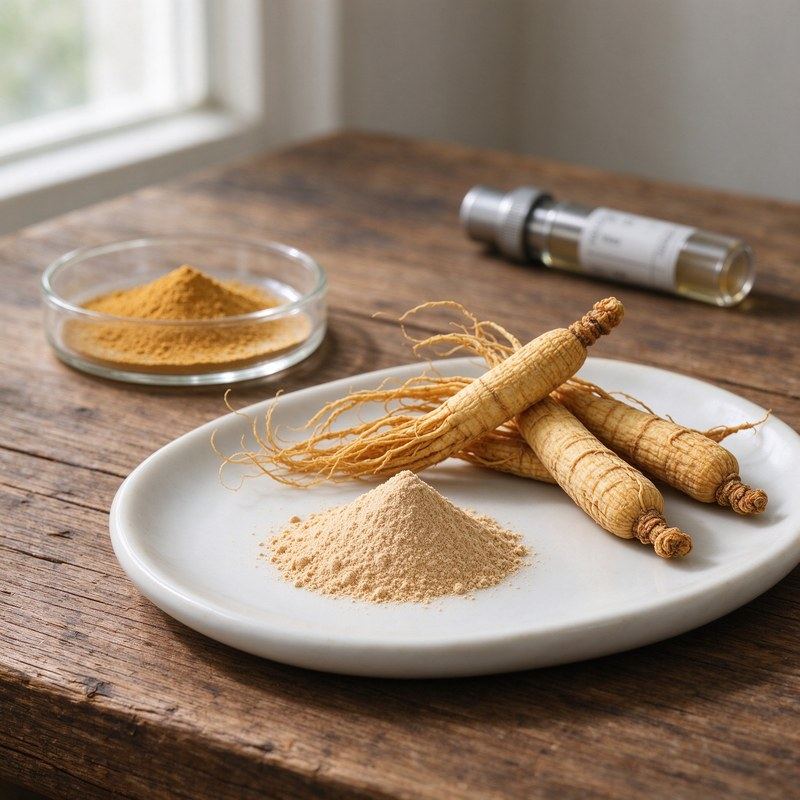
We're talking about a fine, light-to-medium tan powder, usually passing through an 80-mesh screen (100 mesh available on request for beverage applications where sediment matters). It has a characteristic earthy aroma — think damp forest floor after rain — and it's soluble in warm water, though it won't go completely clear. A small amount of insoluble fiber residue is normal; a completely clear, flavorless product would raise a different set of questions.
When you request a sample, ask for 100g — not 10g. 10g is enough to smell but not enough to run a small dissolution test or let your formulator actually weigh out a trial batch.
4. Water extraction vs. ethanol extraction
Two production routes dominate, and they produce genuinely different materials:
Water extraction yields a broader, more complete profile including polysaccharides, which is what most food and beverage buyers want.
Ethanol extraction targets the ginsenoside fraction more efficiently, which is what supplement brands usually specify when they list a percentage on the label.
This isn't a "which is better" question. It's a "which one does your finished product require" question. If your supplier doesn't know which line your material ran on, they're probably buying from a toll processor and reselling. That's not disqualifying — it just means you need to ask who actually owns the drying tower.
5. The QC documents you should actually read
A COA for ginseng extract should contain, at minimum:
HPLC assay for total ginsenosides, with the result above or below the declared spec
Heavy metals: lead, arsenic, cadmium, mercury (we test against USP <232> limits)
Pesticide residue screen (typically 200+ compounds by GC-MS / LC-MS-MS)
Microbial limits: total plate count, yeasts & molds, E. coli, Salmonella
Moisture content and ash content
Solvent residue, if ethanol was used
If the COA you receive is a template PDF with the batch number hand-typed at the top and the rest pre-filled from 2022, that's a document-control problem, not necessarily a product problem — but it's worth asking how their lab records are retained.
6. Packaging, MOQ, and the first order
Standard export packing is a fiber drum with a food-grade polyethylene inner bag, 25kg net per drum. Trial orders are accepted at 1–5kg in foil pouches, which is how most buyers start before committing to a full drum.
Lead time on repeat orders is usually 7–10 working days once the spec is locked, because the standard grades are produced in batches and held in finished-goods inventory. Custom specs (different mesh size, certified organic, Kosher, Halal) add 2–3 weeks and require documentation review.
7. The conversation that should happen before the sample leaves
If you're a brand owner or contract manufacturer, the useful first conversation isn't about price per kilo. It's about:
What finished dosage form you're filling (capsule? tablet? gummy? beverage?)
Whether you need organic certified or conventional
Your target fill weight and the label claim you intend to print
Which retail market you're shipping into, because documentation expectations differ between the EU, the US, and Southeast Asia
That conversation takes 15 minutes on a call and saves two weeks of back-and-forth on samples that don't match what your formulator actually needs.
We supply ginseng extract powder in 5%, 10%, and 20% ginsenoside grades out of our Xi'an facility, with full third-party COA on every batch and 100g samples available for qualified buyers. If you're comparing suppliers on a new project, send us your spec sheet — we'll tell you honestly if your current quote is in the right ballpark, even if you don't order from us.
This page is for B2B procurement and formulation reference. We supply botanical raw material only; we do not make finished consumer products and do not provide consumer health guidance.